

Who hasn't wished that developer documentation could be written automatically or that change logs for software versions could be maintained reliably and without additional effort?
In software development, creating and maintaining existing documentation is not always the most popular task. Sometimes there is no clear responsibility for this task, which means that the information in the documentation quickly becomes outdated or incomplete. In the long term, however, this can lead to technical debt, which unnecessarily complicates further development and maintenance.
Nowadays powerful AI tools known as large language models (LLMs) have been available that can be used precisely for this purpose. They open up new possibilities for creating structured, consistent, and comprehensible documentation.
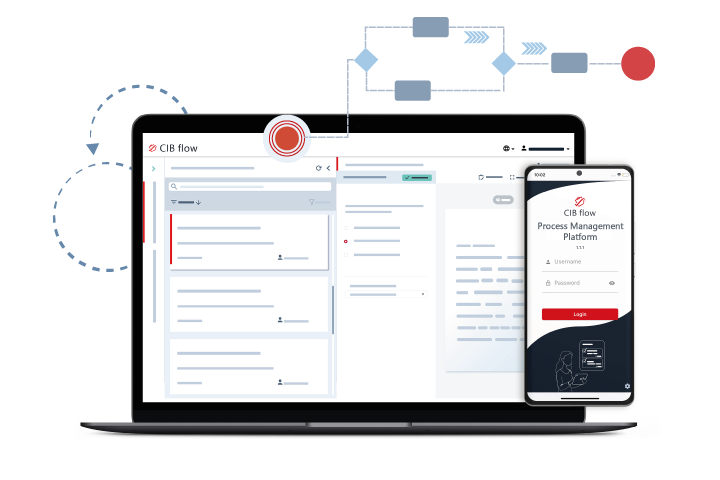
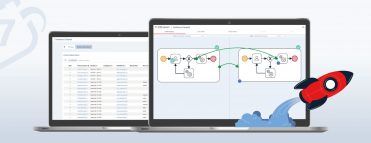
At CIB we have developed a process based on our process platform CIB flow, which addresses this issue and automatically generates complete documentation for approximately 500 CIB flow process modules. To do this, we used AI automation based on LLM models from the US company Anthropic.
How does the process work?
Our process starts automatically every two months. It begins with the receipt of the latest BPM modules in the form of JSON files. With detailed instructions, we apply the LLM model Claude Sonnet 4.0 with a low temperature and a limited number of response tokens.
Once invoked, the model generates fully functional HTML for each module of the process, taking into account multiple CSS classes for different design options. This HTML can be published directly on our e-Learning platform.
Good to know:
The temperature is a parameter that controls the creativity of the model: a low temperature leads to more predictable and precise responses, while a higher temperature leads to more creative and diverse, but less consistent responses.
A token is a small unit of text—it can be a word, a punctuation mark, or part of a word—and corresponds to about four characters on average.
The Claude Sonnet 4.0 model is no longer the latest model. There are now a handful of new models from Anthropic, OpenAI, and Grok, such as Claude Opus 4.5, GPT-5.2, and Grok 4. These are continuously being integrated into our modules. With just a few clicks, our process can also use the newer models!
How can we reduce hallucinations?
Hallucinations are typical errors of LLMs, where the model generates information that is incorrect. This often happens because LLMs work based on probabilities derived from learned patterns rather than genuine understanding. Despite the low temperature we set to obtain precise and less creative responses, hallucinations can still occur.
That is why our process includes post-processing with deterministic elements, such as fixed rules based on specific expressions that recognize and correct certain patterns in the text. We also use an LLM again here to correct further errors and improve the quality of the documentation.
Now, let us discuss the costs:
Conservatively, we estimate that manually creating the documentation, including quality control, for a single process module takes about 30 minutes. Therefore, the total effort for this activity amounts to about 30 working days. In addition, there are considerable opportunity costs, as this time cannot be used for value-adding activities such as customer acquisition or conceptual development.
Our automated approach drastically reduces this effort. Based on the model prices valid at the time of writing this article of approximately 3 € per million input tokens and 14 € per million output tokens, the pure model costs were only around 0.03 € per building block.
This amounts to a total of around 15 € for the complete documentation of all 500 building blocks – compared to several thousand euros for one-time manual creation.

Needless to say, the time savings are also significant: generation, including post-processing, took less than 30 seconds per module. This meant that the entire documentation could be created fully automatically in less than five hours – quickly, consistently, and scalably.
Automation for documentation processes
Therefore, we can conclude that these models are very useful for automating documentation processes. Consider, for example, the creation of change logs for software versions or API documentation that contains standardized sections such as endpoints, responses, and error codes.
User error reports can also be seamlessly transferred to common project management tools such as JIRA (Atlassian) using CIB flow, for example. AI-based LLMs support the process by automatically adding precise error descriptions, well-founded solution proposals, and the appropriate prioritization and task type.
The result: Product managers are noticeably relieved, developers receive clearly structured, understandable tickets – and the team can focus more on strategic and value-adding tasks.
More Business Solutions
The CIB Group specializes in intelligent automation of document creation. One of our core solutions is the powerful template and correspondence system CIB coSys.
CIB coSys allows the creation of complex documents such as bank contracts, insurance claims, notary letters, or municipal documents to be created efficiently and in an audit-proof manner with just a few clicks.
The documents can then be seamlessly transferred to further post-processing steps, such as automated email dispatch or the central printing line CIB fairBrief. This creates a continuous, highly automated document process from creation to dispatch. Let´s CIB!