
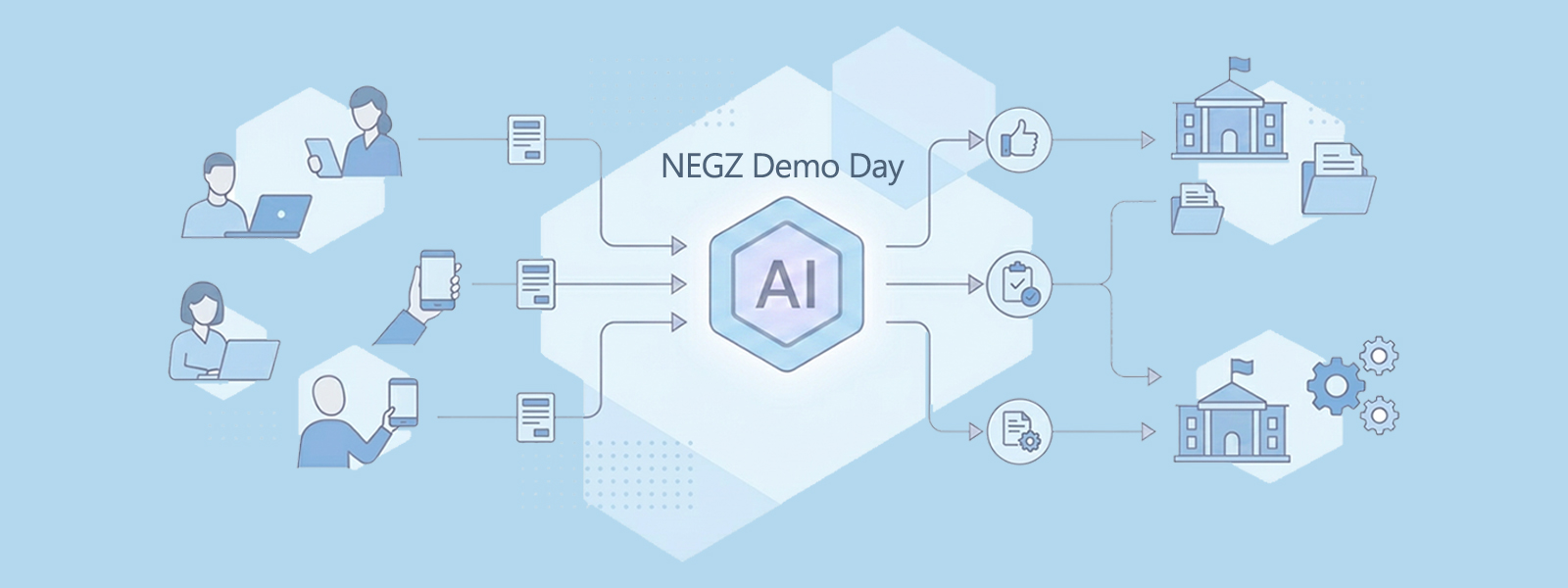

At the same time, government agencies must ensure that data is processed in compliance with the law, that processes are documented transparently, that the models used remain traceable, that decisions are verifiable, and that the systems can be operated securely over the long term.
That is why digital sovereignty is increasingly becoming the key benchmark for modern administrative digitization. The focus is on open source, on-premises operation, European development, migration capabilities, and the ability to flexibly integrate local AI solutions. These factors determine whether public administrations can independently design and further develop digital applications in the long term and leverage the potential of AI.
These are precisely the questions that will be the focus of the first NEGZ Demo Day on June 18, 2026, in Berlin. There, CIB software GmbH will present two solutions specifically designed to meet the requirements of a sovereign and future-proof digitalization of public administration.
As an open-source BPM engine and a fork of Camunda 7 (with an announced end-of-life date of 2030), CIB seven enables the continuation of existing process landscapes without requiring a switch to a completely new architecture. This is of crucial importance for organizations that require stability, planning security, and digital sovereignty.
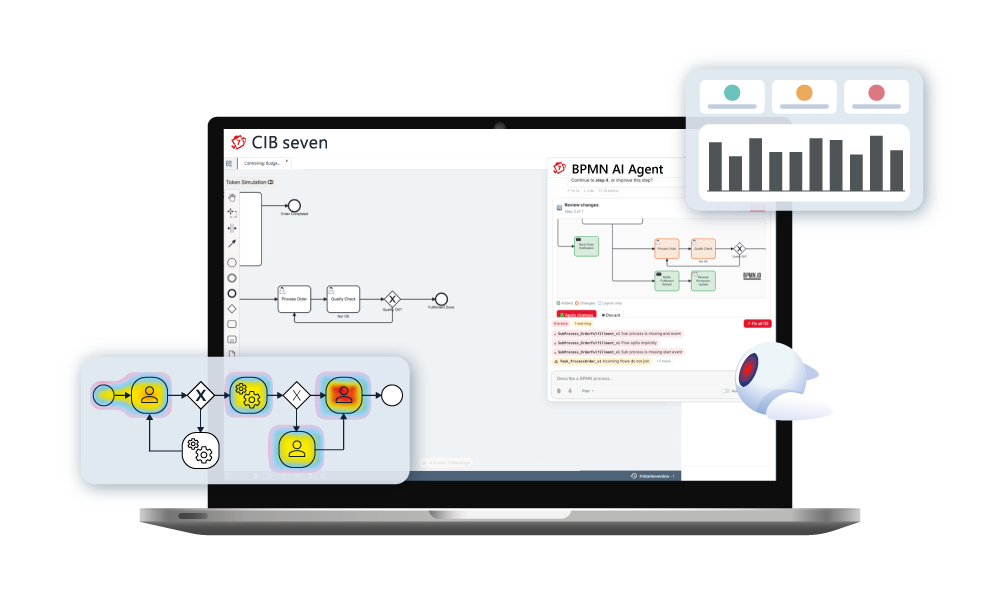
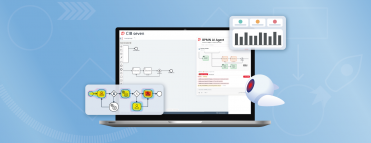
With CIB seven 2.2, CIB is continuing down this path with determination. The new version introduces a modern Web Modeler, AI agents, RAG connectivity, MCP integration, and support for OpenAI-compatible endpoints such as Ollama or vLLM. This means that AI is not viewed as an external add-on, but as an integrable component of controlled BPMN processes.
This is particularly relevant for government agencies. In such settings, it is not enough for AI to simply generate an answer. Rather, the answer must be transparent and verifiable. The AI must be integrated into authorization frameworks and linked to existing process rules.

AI in CIB seven 2.2: BPMN AI Agent and AI Agent Connector
Key new features of CIB seven 2.2 include the BPMN AI Agent—an agent powered by LLM technology for designing, creating, editing, reviewing, and explaining BPMN diagrams directly within Web Modeler EE—as well as the AI Agent Connector. The latter is already available in the open-source Community Edition and enables the placement of an “AI Agent” service task in BPMN models. This AI agent can be provided with a system prompt, a user prompt, and a list of available tools.
This makes the BPMN engine the orchestration layer for AI agents. The advantage is that AI is not operated outside the business process, but is embedded within the process in a controlled manner. Audit logs, restart capabilities, incident handling, and human-in-the-loop control over user tasks remain part of the process architecture.
AI in CIB seven 2.2: BPMN AI Agent and AI Agent Connector
CIB seven’s AI Agent Connector can be flexibly integrated with a variety of AI models and platforms—ranging from leading commercial offerings to locally operated or open-source models. This allows government agencies to decide for themselves whether they want to run the solution entirely in their own data center, on-premises, or in a sovereign German or European cloud.
CIB flow complements CIB seven to form a low-code platform for intelligent automation
While CIB seven provides an open, innovative, and sustainable process engine, CIB flow complements this solution with a web-based low-code BPMN platform. With the help of CIB flow, business departments and IT can jointly model workflows, integrate forms, edit documents within the process, use interfaces, and deploy AI modules.
Together, these elements form an intelligent platform for end-to-end processes—from application submission through review and document processing to decision-making, notification, and archiving.
Conclusion
Development for digital government. CIB positions itself precisely at the interface that is particularly relevant to government agencies today, offering open process automation, seamless operation, migration capabilities, AI integration, and practical low-code solutions.
This is not just a question of how quickly an application can be developed. It is also a question of who owns the process architecture of tomorrow’s digital government.
With CIB seven and CIB flow, the answer is: it remains customizable.