


CIB seven 2.2 expands the BPM platform with key features for AI-powered process orchestration, browser-based modeling, and enterprise collaboration. In an exclusive online preview with more than 100 participants, the CIB team presented the most important new features of the upcoming version: the new Web Modeler, an AI agent framework for BPMN workflows, human-in-the-loop scenarios, RAG integration with PostgreSQL/pgvector, and new capabilities for MCP connectivity and agent-based process automation.
The session was moderated by Key Consultant Tom Gartmann. Product Owner Oleg Skrypnyuk provided a first look at the next major version of CIB seven and demonstrated how AI and BPM are increasingly being integrated into modern enterprise automation.
The most important new features in CIB seven 2.2
CIB seven 2.2 introduces several key enhancements:
- A new browser-based web modeler for BPMN,DMN, and forms
- An AI agent framework for embedding AI into BPMN processes
- Human-in-the-loop workflows for controlled AI results
- RAG integration with PostgreSQL and pgvector
- MCP connectivity for using external tools
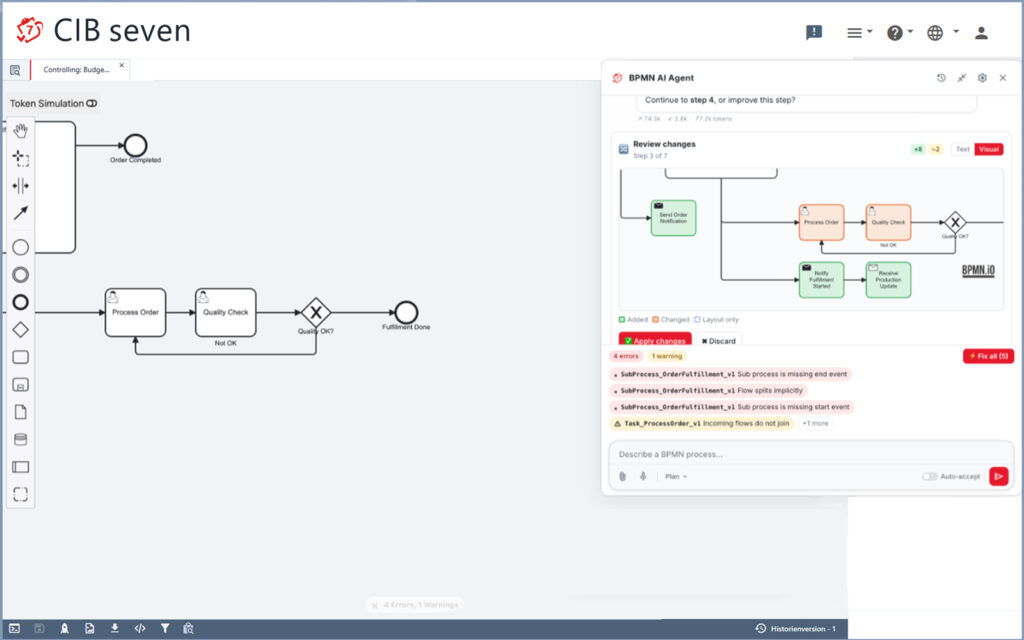
- A BPMN AI Assistant for AI-assisted process modeling
- New enterprise features for versioning, collaboration, and model comparison
As a result, CIB seven is steadily evolving from a BPM engine into an AI-enabled platform for process orchestration.
Platform Upgrade: Spring Boot 4 and Migration Capability
Oleg demonstrated CIB seven with Spring Boot 4 support as well as backward compatibility with Spring Boot 3.5 artifacts. This is intended to allow companies to gradually evolve their existing setups without compromising on stability or investment security.
New Web Modeler for BPMN, DMN, and Forms
A key highlight of the preview was the new Web Modeler. It is available in both the Community and Enterprise editions and allows users to create and edit models directly in the browser.
With the Web Modeler, users can:
- Create BPMN, DMN, and form models directly in the browser
- Import and export BPMN files
- Deploy processes directly to running engines
- Test processes locally or in staging environments
- View BPMN XML directly in the editor
- Visually validate and debug BPMN models
The Enterprise Edition expands these features to include additional capabilities for professional development and team processes:
- BPMN Versioning and Snapshots
- Diagram Comparisons
- Collaborative Editing
- Protection Against Accidental Overwriting
- Token Simulation
- SVG Export
As a result, the Web Modeler supports both individual process developers and teams that collaborate to create, review, and refine BPMN models.
CIB Seven AI Agent Framework: AI Directly Integrated into BPMN Processes
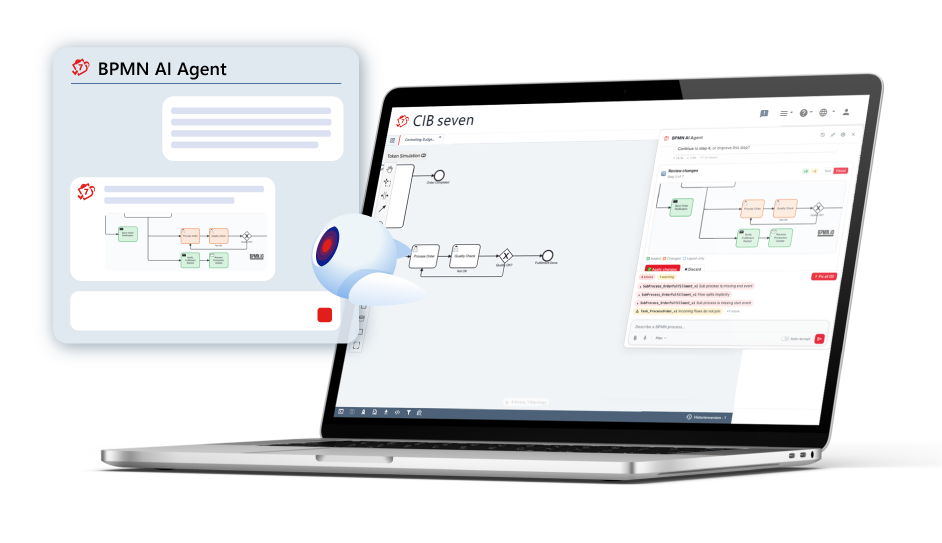
The session focused on the new CIB seven AI Agent framework. It enables the direct embedding of AI agents into BPMN workflows. This is made possible by BPMN element templates and a connector architecture based on LangChain4j.
The live demo showed how AI agents can be used within processes. Among other things, they can:
- Execute prompts directly within BPMN processes
- Manage conversation context and memory
- Work in human-in-the-loop scenarios
- Use external tools and MCP servers
- Trigger subprocesses
- Analyze customer feedback
- Generate summaries and sentiment analyses
- Interact with Retrieval-Augmented Generation (RAG) knowledge bases
The outlook is clear: In the future, AI agents will not only be able to support processes, but also utilize individual process steps, external tools, and other BPMN processes as callable building blocks. This opens up new possibilities for agent-based process automation and dynamic orchestration.
At the same time, the architecture of CIB seven remains modular. Companies that do not require AI capabilities can continue to run lean deployments without additional AI dependencies.
Human-in-the-Loop: Governance for AI-powered Workflows
Another key focus of the preview was the question of how AI results can be monitored, reviewed, and improved. The demo showed how AI-generated responses are reviewed and refined by humans during the process.
The workflow shown allowed users to:
- Submit a prompt
- Receive an AI-generated result
- Request revisions such as “Make it shorter,”
- Send feedback to the LLM along with the saved conversation context
- Approve the final result
The example illustrated how BPMN orchestration can bring governance, traceability, and control to AI-powered workflows. This approach is particularly important for enterprise scenarios because AI results are not generated in isolation but are embedded in clearly defined review and approval processes.
RAG and Knowledge Base Integration
CIB seven 2.2 also introduces features for Retrieval-Augmented Generation, or RAG for short. This enables companies to leverage company-specific knowledge directly within AI-powered BPMN processes.
The preview showcased an integration based on PostgreSQL and pgvector. Among other things, the following were demonstrated:
- Retrieving corporate knowledge during process execution
- Enriching AI-generated responses with internal corporate data
This creates new use cases for intelligent customer support, internal knowledge assistants, AI-powered process decisions, and the expansion of enterprise-wide search.
Modelado BPMN basado en IA
Another key new feature is the BPMN AI Assistant, which is integrated directly into the Enterprise Web Modeler. It helps users understand, create, and customize BPMN models more quickly.
Users can:
- Ask questions about existing BPMN diagrams
- Generate complete BPMN processes from prompts
- Edit BPMN models using natural language
- Add tasks, gateways, and logic via voice or text commands
- Automatically deploy generated diagrams
The wizard supports the Ask, Edit, and Plan modes. This lowers the barrier to entry for process modeling, while enabling development teams to design and iterate on BPMN workflows more quickly.
Questions from the community
During the Q&A session, the community showed great interest in topics such as the Web Modeler's deployment options, AI integration architectures, PostgreSQL requirements, MCP server integrations, and enterprise collaboration features.
The CIB team reiterated that compatibility, modularity, and seamless migration remain key priorities.
What's next
The recording of the Preview Session has been posted on YouTube, so anyone interested can watch all the demos and discussions again.
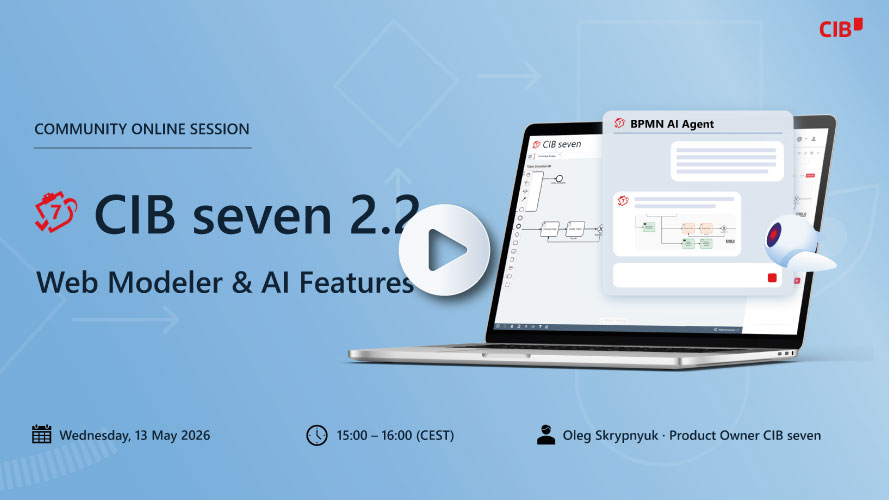
The release of CIB seven 2.2 is scheduled for late May 2026. Additional AI and collaboration features are already planned for the fall release cycle.
The preview made it clear: CIB seven is evolving from a BPM engine into a powerful, AI-enabled platform for process orchestration. The platform remains open, compatible, modular, and designed for enterprise use.