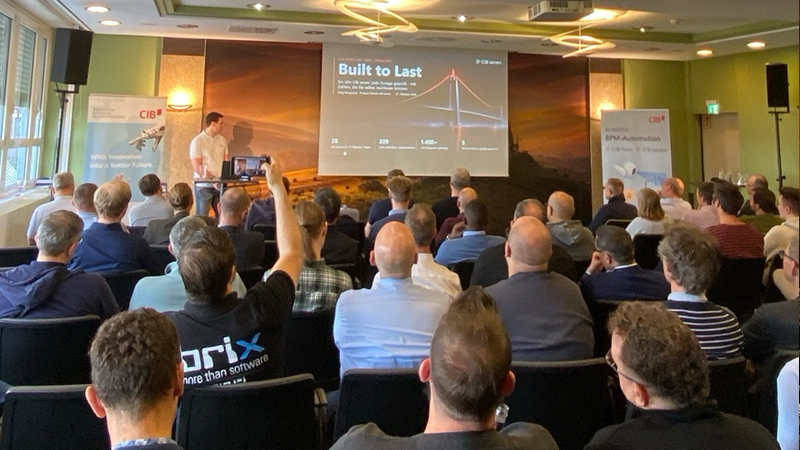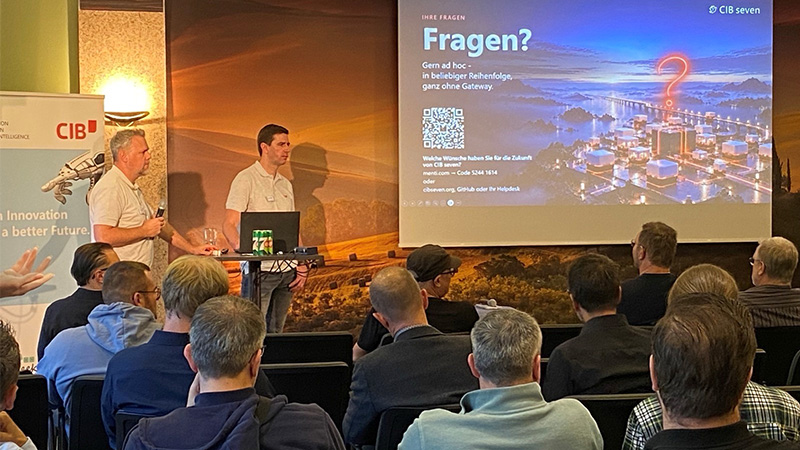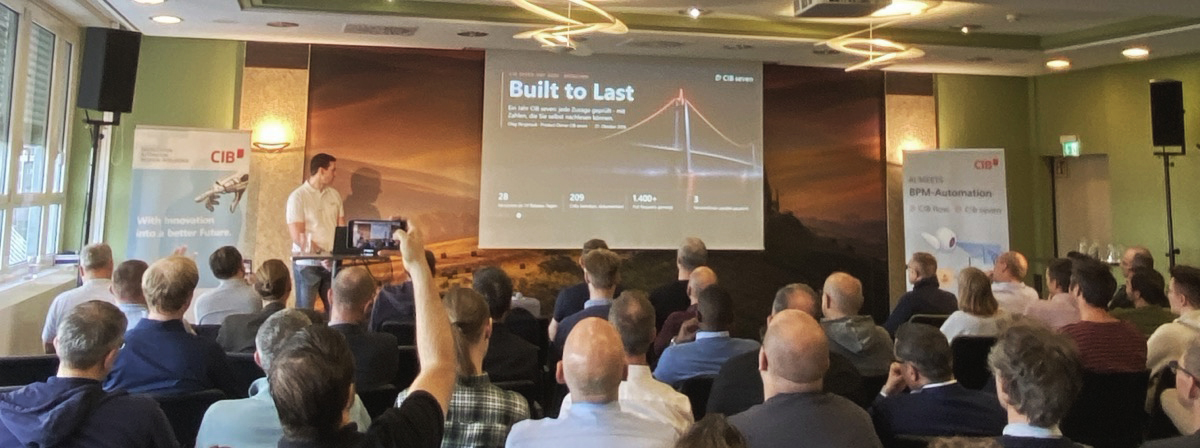
The CIB seven Day on October 27 in Munich demonstrated just how much the community surrounding CIB seven has grown: About 70 users, partners, and interested parties came together, many of whom have their own projects in production. The focus was on case studies regarding the migration to Camunda 7, a preview of CIB seven 3.0, and the question of how Artificial Intelligence (AI) and Business Process Model and Notation (BPMN) can be meaningfully integrated.
Anyone who uses the BPM engine or is planning to switch to it gains a concise overview in just one day: what works in practice, where the platform is headed, and how AI agents can be integrated into business processes in a controlled manner.

Who participated in the CIB Seven Day 2026?
Kevin Lang, Head of Process Management at brix Solutions AG, was particularly struck by the community’s growth. Compared to last year, there were significantly more attendees on-site, and many of them are already using the platform. “For me, this is a good sign of how the CIB seven community is developing,” he wrote afterward on LinkedIn.
Whether it's migrating from Camunda 7, existing process architectures, or new use cases: The talks by BAUR Versand, Ceyoniq Technology, Miragon, mesoneer and PiU demonstrated just how varied the requirements for process automation can be.
What practical experiences did users and partners share?
The community talks covered a broad range of topics:
- Manfred Löbling, Team Leader, Development & Automation, and Max Böhling, application developer at BAUR Versand, demonstrated how the company uses CIB seven for internal approval processes and how its own architecture has evolved to support this.
- Marcel Mühlbach, Product Manager at Ceyoniq Technology, Under the title “Migration without drama: now the exciting part begins”, explained how business processes can be not only migrated with the nscale Process Automation Platform and CIB seven, but also further automated in an intelligent way. His analogy came from basketball: good individual players are not enough; it is the way the team works together that makes the difference.
- Dominik Horn, co-founder and transformation lead at Miragon, described how AI has transformed the software development of an intralogistics solution at dmTECH and how AI and BPMN can be combined in this process.
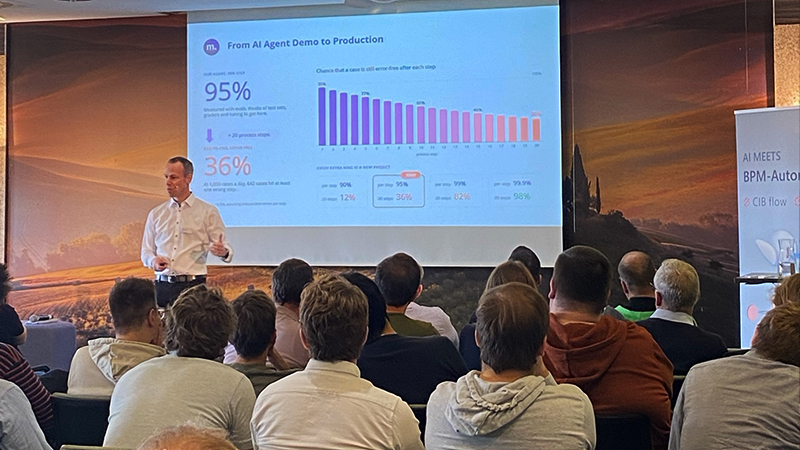
- Dirk Budke, Head of Development at mesoneer, explored whether AI agents will replace traditional workflows and examined the role structured processes will continue to play in an increasingly AI-driven working environment.
- Marcin Pankowski, Business Process Engineer at PiU, demonstrated how process automation supports banks and insurance companies in customer verification based on the “Know Your Customer” principle.
The focus was not solely on technical solutions. Issues such as long-term maintainability, open standards, and the integration of new technologies also played an important role.
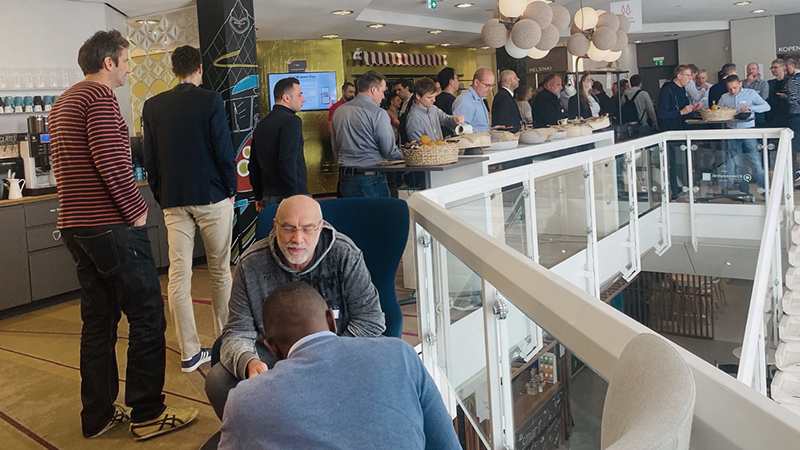
Between the presentations, the day provided opportunities for one-on-one conversations. Over lunch and during networking sessions, participants were able to make connections, share experiences, and gain new ideas for their own projects. Many of the conversations that took place there showed that it was precisely the diverse perspectives offered by the presentations and the exchanges during the breaks that made the day particularly valuable.
How can AI agents be given clear guidelines in BPMN processes?
In addition to practical experience, the focus was on technological developments related to CIB seven. Particular emphasis was placed on the interaction between AI agents and BPMN processes: How can existing workflows be enhanced with agent-based functions, and what possibilities does the Model Context Protocol (MCP) open up?
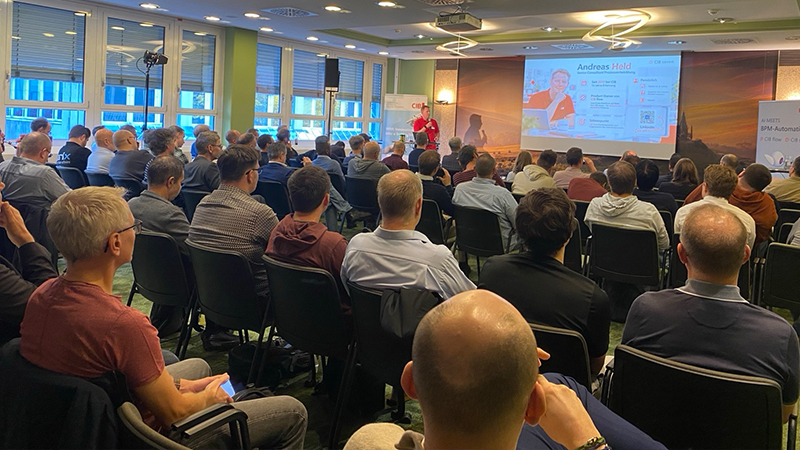
MCP is an open standard that allows AI applications to access external systems and data. Andreas Held, Senior Consultant for Process Development at the CIB Group, demonstrated in his presentation “CIB seven meets MCP” how users can use this approach to interact with their process engine. MCP opens up new possibilities for companies: AI assistants make complex process information accessible via natural language and enable intelligent collaboration across system boundaries.
What will CIB seven 3.0 bring in November 2026?
With a look ahead to CIB seven 3.0 and the roadmap for 2027, the product team presented the next steps in development. The version scheduled for November 2026 will include, among other things:
Ad-hoc Subprocesses
Not every workflow can be defined step by step in advance. In ad hoc subprocesses, employees or AI agents decide which tasks are necessary as they work through the process, within the framework specified by the process model.
An enhanced AI Agent Connector
Integrates language models directly into process steps, so that AI tasks become part of the modeled workflow.
CIB seven as an MCP server
AI applications can access processes directly via the Model Context Protocol, for example, to retrieve information or trigger workflows.
Further developments are planned for 2027, including real-time collaborative modeling and communication between AI agents.
How is community feedback incorporated into future development?
To wrap things up, Frank Seboldt and Vincent Roth, senior consultant for process automation and BPM at the CIB Group, discussed participants’ requirements for future development during a “wish list” session. This actively solicited feedback from the community, allowing users and partners to directly shape the future development of CIB seven.
Conclusion: Open process automation is growing along with its community
CIB seven Day 2026 demonstrated that reliability and innovation are not mutually exclusive. Users report productive deployments and successful migrations; the product team is purposefully expanding the platform for AI-powered workflows; and the community is helping shape the next steps. For companies seeking to automate their processes in an open and independent manner over the long term, this provides a solid foundation.
A heartfelt thank you to all the speakers, participants, and partners who enriched the day with their contributions, questions, and discussions. We look forward to shaping the next steps for CIB seven together with our community.
All presentations and video recordings can be found on the event page: CIB seven Day 2026
Frequently asked questions
CIB seven Day 2026 took place on October 27, 2026, at smartvillage in Munich. Users, partners, and the product team from CIB seven presented real-world projects and new developments there.
The version scheduled for November 2026 will include, among other features, ad hoc subprocesses, an enhanced AI Agent Connector, and the ability to use CIB seven as an MCP server.
BPMN sets the boundaries within which AI agents are allowed to operate. Where the path is known, processes follow a strictly defined course; where only the goal is known, AI agents can make flexible decisions.
The presentation slides are available for download; video recordings will be posted shortly on the event page.