


Accessible PDFs are no longer a niche topic. Government agencies, companies, and organizations face the challenge of making large volumes of existing documents accessible. At the same time, legal requirements for digital accessibility are increasing.
This assessment shows that AI-powered document analysis can already carry out important preparatory work in the creation of accessible PDFs.
What c't highlights in its hands-on test
Accessible PDFs consist of more than just readable text. The semantic structure is crucial: headings, paragraphs, lists, tables, alternative text, and the correct reading order must be marked up in such a way that screen readers can present the content in a meaningful way.
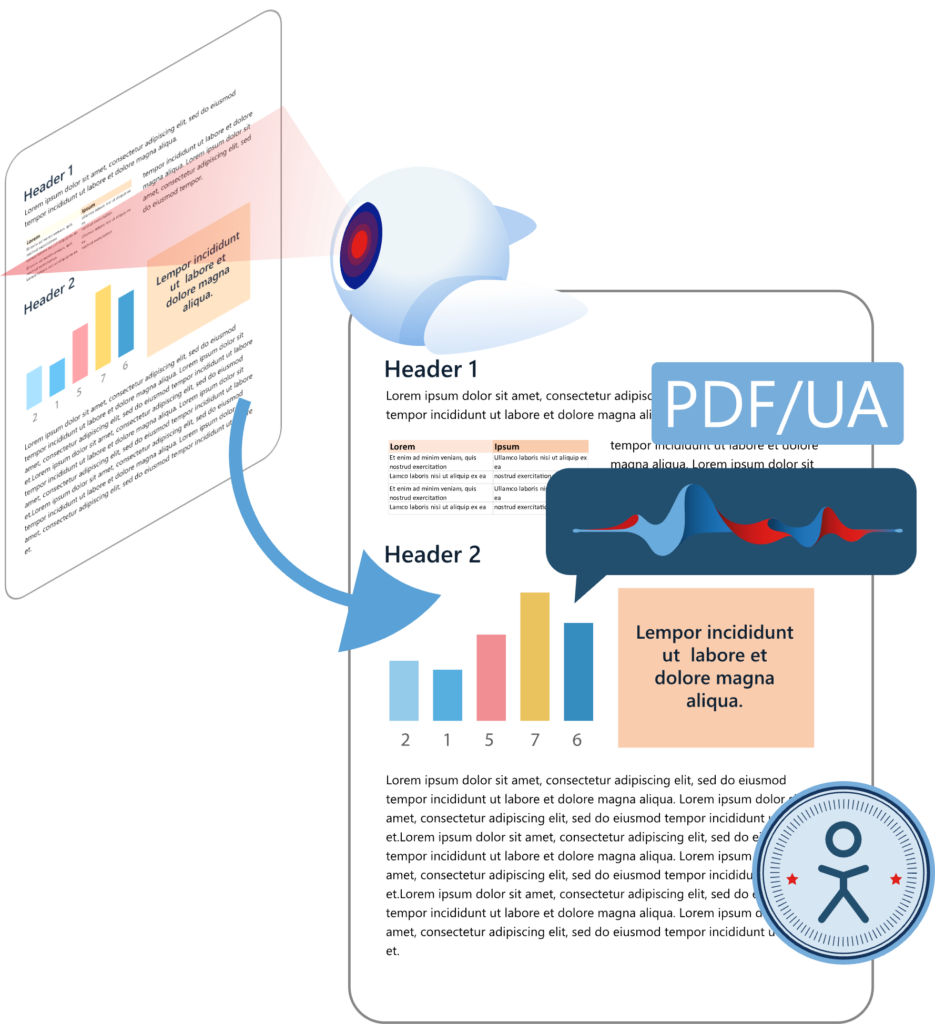
CIB ridmi addresses precisely these tasks. The AI analyzes the layout, text blocks, and document structure, identifies key content elements, and uses them to generate the tag structure required for PDF/UA.
The journalist gives a particularly positive assessment of the quality of the automatic structure reconstruction:

The solution also produced impressive results with standard tables. The editorial team emphasizes that these were rendered correctly even when no header row was defined in the source document.
Why automation Is becoming indispensable
Many organizations have thousands or even millions of existing PDF documents. A complete manual post-processing is often neither economically nor organizationally feasible.
AI does not replace quality control. However, it can automate the most time-consuming steps:
- Identify document structures
- Derive heading hierarchies
- Reconstruct reading order
- Organize lists and tables
- Generate technical tags
This transforms a purely manual process into a significantly more efficient workflow, allowing specialists to focus their time on the actual quality inspection.
Realistic rather than fully automated
At the same time, c't points out that fully automated accessibility remains a challenge when it comes to complex documents.
We wholeheartedly agree with this assessment. AI is not a magic wand, but rather a powerful assistance and automation technology. Human review remains indispensable, especially when dealing with complex layouts, technically sensitive alternative texts, or sophisticated specialized tables.
The key difference is that AI can already handle a large part of the preliminary work today.
Development with Strong Research Partners



This combination of AI research, document expertise, and practical requirements from government and business continues to shape the development of the solution to this day.
Consulting Services
The c’t practical test shows that AI-powered PDF accessibility is no longer just a vision of the future. Even today, automated processes can handle key steps in document preparation and help organizations make their existing PDF collections accessible much more efficiently.
For us, the c’t review is both a validation and an incentive. The results show that modern AI has already reached a high level of maturity in the analysis and structuring of documents. At the same time, we are continuously working to further improve automation, quality, and traceability.
Accessibility isn't achieved with a single click. But intelligent automation can significantly shorten the path to achieving it.
Mit PDF-Barrierefreiheit starten?