


Court rulings contain a wide range of personal and other sensitive information that must be identified, evaluated in context, and specifically protected before publication. At the same time, the legal reasoning should remain understandable: What facts were decisive, and how did the court reach its conclusion?
Anyone who wants to anonymize court rulings must therefore do more than simply cover names with black bars. Artificial intelligence can help identify potentially sensitive information. It remains essential to have a process in which users review the results, fill in any omissions, and perform a final check of the file intended for publication.
Why Black Bars Alone Are Not Enough
Simply obscuring sensitive content visually does not constitute secure redaction. If the original text remains in the PDF, it may still be possible to copy or extract it under certain circumstances. Technically correct redaction, on the other hand, permanently removes the selected text and image content from the document, so that it is no longer technically accessible.

Context is important
Not every piece of potentially sensitive information needs to be redacted in the same way in every document. The key factors are the applicable privacy regulations, the context, and the importance of the information to understanding the decision.
The goal is to remove information that should be protected while preserving the substance of the ruling as much as possible.

Configurable guidelines help address different requirements. For example, the organization specifies which data groups—known as entity classes—should be given special consideration in each process. These may include names, addresses, or other identifying information. Users review the individual data points based on these guidelines and determine which adjustments are necessary in the specific context.
Example: Why Monetary Amounts Require Case-by-Case Decisions
Monetary amounts illustrate why rigid, blanket rules are insufficient. A purchase price, the amount of damages, or an award of damages can be essential to understanding a judgment. If the relevant information is removed, it may no longer be possible to fully understand the decision.
On the other hand, an amount may contribute to identifying a person or case when combined with other information. A possible example is a purchase price that, when combined with a specific location and an unusual description of the item, makes it possible to identify a publicly known business. In such cases, it is not the amount alone that is decisive, but the combination of information. For processing purposes, this means that monetary amounts should not be redacted indiscriminately. Document-type-specific guidelines can support the review; however, evaluating individual instances in context remains important.
AI-Powered Entity Recognition for Large Document Collections
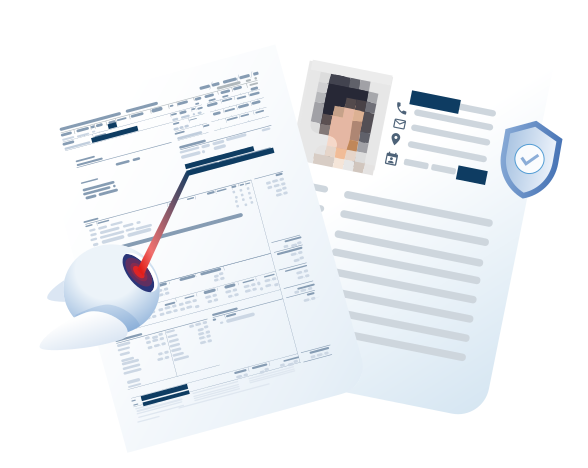
Manually processing individual documents can be useful. For larger volumes, automated recognition can be helpful. CIB PoP (Protect our Privacy) is an AI-powered solution for detecting and removing personally identifiable information from documents. The solution is also designed to process large volumes of documents.
Automatic detection should serve as the starting point for further review—not its conclusion. Users check the detected areas, evaluate them in context, and make any necessary corrections.
Attention should also be paid to content that is not included in the automatic suggestions. During a technical review, for example, handwritten additions, signatures, or identifying elements in images may be relevant. Which content actually needs to be protected depends on the specific document and the underlying requirements.
An AI-powered process combines automated detection with expert review: The technology supports the processing, while the responsibility for evaluating the results remains with the appropriate personnel.
How to Verify the Quality and Completeness of Anonymization
Even a largely automated anonymization process requires a final quality check. Additional verification options, such as a text-based search or the specific consideration of uppercase and lowercase letters, are helpful in this regard.
For organizations with defined review and approval processes, CIB flow can consolidate the individual steps into a structured workflow. Among other things, the platform supports document processing, task management, rights management, and logging. CIB PoP can also be integrated into relevant processes as an AI module.

A possible workflow ranges from automated detection through subject-matter review and technical verification of results to the approval of the final version for publication. Responsibilities and required review steps are defined accordingly to meet the organization’s requirements.
Process automation does not replace professional judgment. Rather, it supports the systematic execution and documentation of such decisions.
Conclusion: Secure publication is a collaborative effort
Anonymizing court rulings is neither a single step nor merely a matter of the technology used. The key lies in the interplay of four components:
- automated detection
- context-based verification
- permanent removal
- documented approval
Such a procedure is intended to protect personal information while, at the same time, preserving the legal validity of the decision as much as possible. This requires clear guidelines and verification of the actual version published.
CIB PoP identifies sensitive, personal information and processes it in a targeted manner. When used in combination with CIB flow, the subsequent review and approval steps can be mapped and controlled as a structured process.
Frequently asked questions
A black bar can only obscure the text beneath it. If this text remains in the PDF, it may still be possible to copy, search, or extract it under certain circumstances. Technically correct redaction, on the other hand, permanently removes the selected content from the published version.
A quality control process can combine various verification steps, such as a targeted text search and the verification of identified entities. It is also important that the quality control process be traceable and repeatable.
Process automation can help to systematically map and document inspection steps, responsibilities, and approvals.
Processing large volumes of documents manually is extremely time-consuming. Automated entity recognition can quickly identify relevant content, thereby speeding up the processing.
Human review remains particularly important in situations where context-based decisions are required or where information cannot be reliably identified by automated systems.