
Why BAUR Was Looking for an Alternative for Its Process Landscape
BAUR operated an internal process portal based on Camunda 7 Community Edition. This portal was used to manage key processes in the areas of human resources, procurement, and approvals. The processes, which had evolved over the years, were deeply integrated into the existing IT landscape.
With the announced end of support, the question arose as to how this process landscape could continue to be operated reliably and cost-effectively. A comprehensive platform migration was not an option. Since the affected internal processes do not directly contribute to revenue, BAUR determined that the cost of a comprehensive migration was not commensurate with the expected benefits.
In addition, there were technical requirements. At the time of the evaluation, BAUR felt that Camunda 8 did not yet offer all the necessary features, particularly in the areas of BPMN and the REST API.
Therefore, they were looking for an alternative that would preserve existing processes and integrations while also providing planning certainty.
What Remained Unchanged at BAUR After the Change
With CIB seven, BAUR was able to continue using existing BPMN processes and processes in Decision Model and Notation (DMN)—the notation for decision rules—without any changes. The REST-based integrations and the company’s own front end also continued to run without any modifications. There was no need to rebuild process models or make fundamental changes to interfaces.
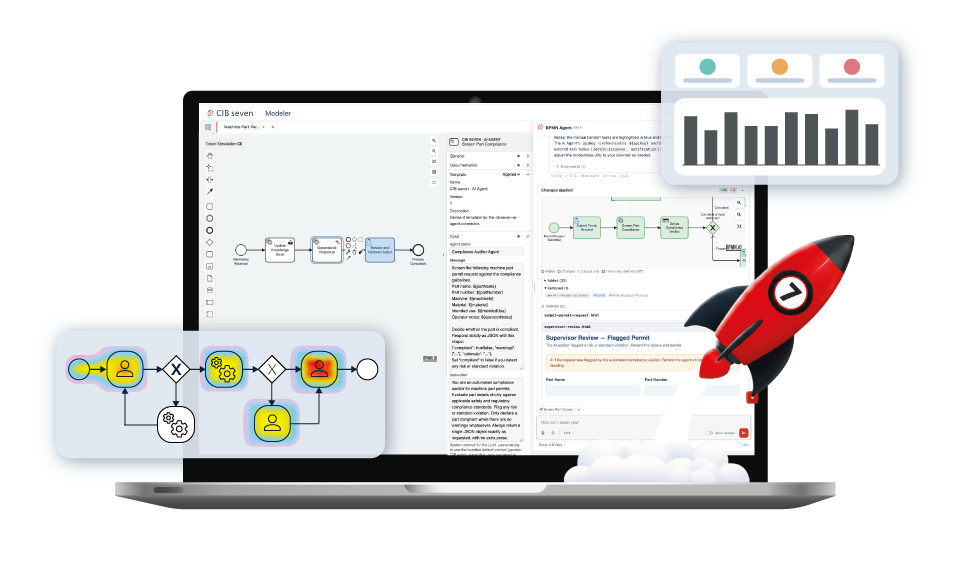
Regular security updates and bug fixes contribute to stable and secure operation and provide long-term planning certainty.
The technical review was conducted in a test environment, taking into account all relevant regulatory, security, and compliance requirements.
One month of project time, room for growth
Since going live, CIB seven has been running approximately 11,000 process executions per year. In addition, there are approximately 21,000 decision instances—that is, executions of rule-based decisions.
The contractual framework covers up to 200,000 process instances per year. This gives BAUR the flexibility to handle increasing process volumes without having to fundamentally change the existing process architecture.
up to 200,000 court instances covered
more than 21,000 decision-making bodies
over 11,000 process runs per year
Three Questions to Consider Before Deciding Between Migration and Continued Operation
BAUR based its decision on cost, functionality, and compatibility. These three factors can also help other organizations assess their current situation:
Cost-Effectiveness
What specific benefits does a comprehensive migration offer in relation to costs, effort, and the requirements of existing processes?
Functionality
Which features for BPMN, DMN, and integrations are actually needed, and which platform provides them?
Compatibility and Operation
Can existing models, interfaces, and applications continue to be used with a regularly maintained alternative?
Those who answer them early make decisions based on their own needs, rather than under time pressure.
Conclusion: What matters most is what your own processes require
The BAUR example shows that the end of support for a platform does not necessarily require a comprehensive migration. With CIB seven, the company was able to retain its existing processes and integrations and ensure long-term operation.
Instead of investing resources in a complex system migration, BAUR can focus on further developing its internal workflows.
What does the future hold for your Camunda 7 process landscape?
Learn how you can continue to run your existing processes with CIB seven and what options are available for your system landscape.
Frequently asked questions
No, a comprehensive platform migration is not absolutely necessary. BAUR chose CIB seven so it could continue to run its existing processes and integrations without a fundamental overhaul. Whether this approach is suitable depends on the technical and economic requirements.
Yes. At BAUR, existing BPMN and DMN processes, REST-based integrations, and the company’s own front end could continue to be used without modification. The actual effort required for the migration depends on the specific system landscape.
BAUR successfully deployed CIB seven into production within one month, with no downtime. Prior to the production launch, the solution was tested in a test environment. At the same time, the contractual documents underwent legal review.