The automated creation of large volumes of accessible PDF documents poses particular challenges for banks, insurance companies, government agencies, and businesses. Manual post-processing is hardly feasible when dealing with thousands or millions of documents. Therefore, it is crucial to ensure high PDF/UA compliance from the document creation stage.
How well this approach works in practice was independently assessed by Pfennigparade Business. Inklusiv. based on the PDF/UA output of the correspondence management system (CCM) CIB coSys. The results were highly positive: The document structure generated in the very first test already showed a very high level of quality. Only a few minor corrections were required. ```

Karin Brand, Project Developer and Web Accessibility Tester at Pfennigparade Business. Inklusiv., was particularly impressed by the quality of the automatically generated PDF/UA structure in the first test.

In contrast, solutions from other providers often require significantly more post-processing.
Independent Field Test: High PDF/UA Quality Right from the First Run
Karin Brand reports that, when testing other automated systems, she repeatedly comes across PDFs that lack basic semantic structures. In some cases, documents aren't even tagged sufficiently to allow for meaningful testing.
In the case of the CIB release, the initial situation was significantly different. The basic document structure had already achieved a high level of quality during the first test. There were no major problems, such as issues with the reading order or the markup of document elements.
Her recommendation is equally positive. When asked whether she would recommend the solution to other organizations, Brand answers with a resounding “yes.” For her, the decisive factor is, in particular, the high quality of the generated PDF/UA structure right from the first run.
Why PDF/UA Quality Is Crucial for Large Volumes of Documents
A single PDF can be manually reviewed and adjusted as needed. However, this approach is not scalable in automated output management processes. Every day, businesses and government agencies generate thousands to millions of standardized and personalized documents—ranging from official notices and contract documents to customer information and business correspondence.
With such large volumes of documents, accessibility must be taken into account right from the document creation stage. Only when relevant structures are created automatically and in a reproducible manner can consistent PDF/UA quality be achieved across the board, without having to manually edit each individual document afterward.

In addition, regulatory requirements are increasing the pressure to act. The Act to Strengthen Accessibility (BFSG) has required, among others, providers of certain banking services for consumers and e-commerce services to comply with relevant accessibility requirements since June 28, 2025.
For the organizations involved, this raises not only the question of how to create accessible documents, but also how to reliably ensure that the required quality is integrated into existing processes.
Accessibility from the Start: CIB Approach to Document Creation
For Ms. Brand, a key factor for success is not waiting until after a document is finished to incorporate accessibility features. If accessibility is taken into account from the very beginning—during the design and document creation phases—unnecessary and costly rework can be avoided.
Dieser Grundgedanke findet sich auch in der CIB-Dokumentenerzeugung wieder. CIB coSys unterstützt die zentrale Vorlagenverwaltung und automatisierte Erstellung von barrierefreien Dokumenten.
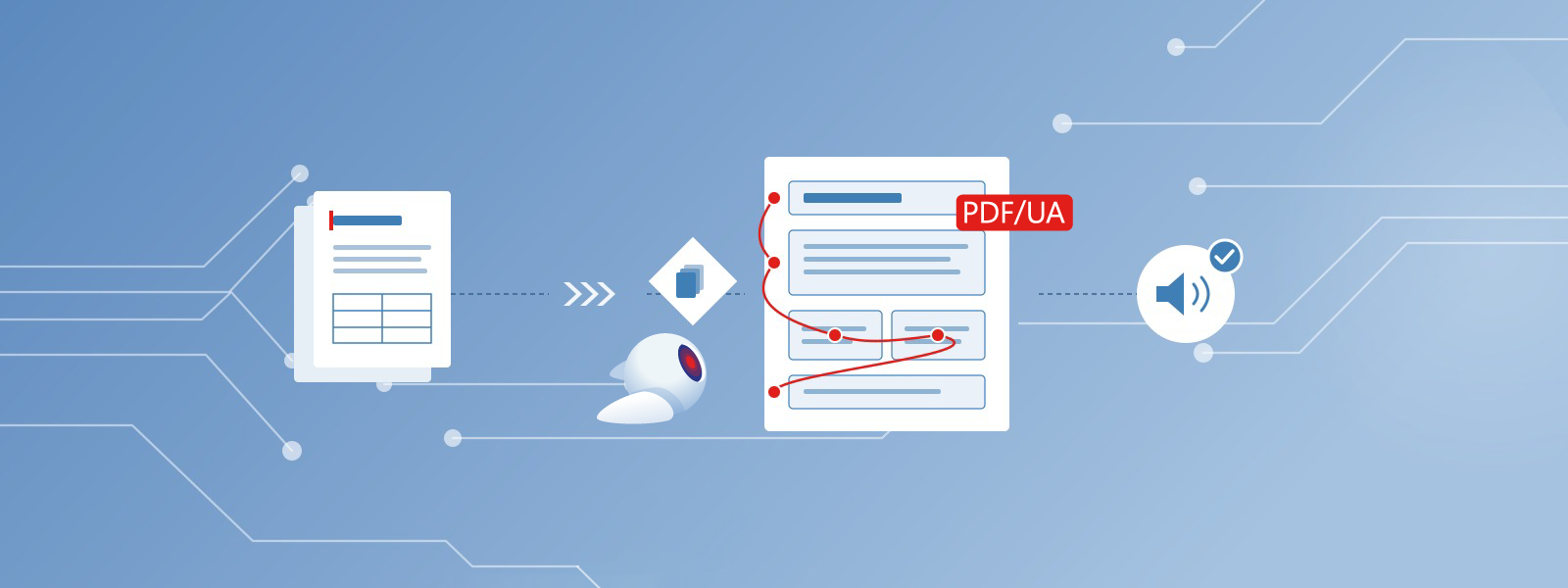
The key technical approach involves utilizing existing semantic information during the document creation process. For example, if headings, tables, or other structural elements are properly marked up in the templates, this information can be carried over into the PDF/UA output. This eliminates the need to reconstruct the meaning of the document elements from the finished PDF after the fact.
An example from the interview illustrates how this approach affects practical usability: so-called layout tables. These may be necessary, for example, in business letters to position content correctly from a design perspective. For people who use a screen reader, however, such tables should not be read aloud as if they were data tables.
CIB can semantically parse these purely presentational tables during PDF/UA generation and output the information they contain in a defined reading order. Ms Brand viewed this approach positively, as it ensures that navigation using assistive technologies is not hindered by a table structure that is inappropriate for the content.
This example illustrates what matters most in automated PDF/UA generation: not just a formally correct tag structure, but a meaningful presentation of the document's content that is accessible to assistive technologies.
Automation and human review complement each other
Automated PDF/UA generation makes it possible to efficiently and consistently provide accessible versions of even large volumes of documents. Technical validation tools such as the PDF Accessibility Checker (PAC) can help systematically verify the generated structure.
As the web accessibility expert points out, however, a technical review is no substitute for practical use:
The key, therefore, is how these elements work together: Automation lays the foundation for scalable processes, technical reviews support quality assurance, and practical tests show whether the documents are actually usable.
Accessible Document Creation as an Integral Part of Scalable Business Processes
Frequently asked questions
No. Automated testing tools such as the PDF Accessibility Checker (PAC) can verify technical requirements and detect errors in the document structure. However, they do not fully demonstrate whether a document is meaningfully accessible in practical use with assistive technologies.
When dealing with large volumes of documents, consistent quality, stable processes, and the accurate preservation of semantic structures are particularly crucial. Accessibility should therefore not be added only after the PDF has been created, but should be taken into account early in the document process.
Pfennigparade Business. Inklusiv. assessed the PDF/UA output of CIB coSys as part of an independent accessibility assessment. The assessment examined the technical properties of the document structure as well as its practical usability with assistive technologies. Compared with many other automatically generated PDFs, the underlying structure was already well developed, with only a few detailed corrections required.